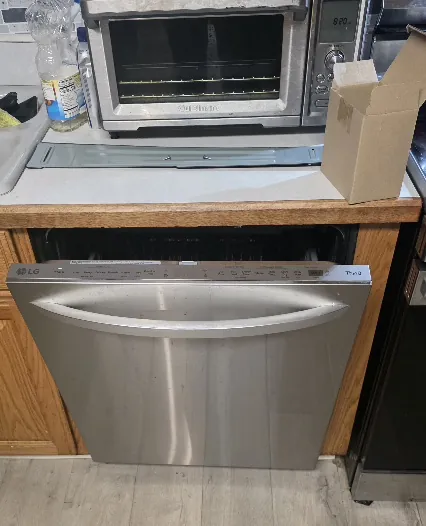
A dishwasher that finishes with water in the bottom is frustrating for a simple reason: it leaves you with wet dishes, a machine you cannot trust, and a kitchen task that should have been done already. Sometimes the cause is a food particle in an owner-accessible filter or a visible kink in the drain connection. Other times, the problem is in the pump, the plumbing connection, or an installation detail that needs a closer look.
The goal is not to take the dishwasher apart, pour chemicals into it, or guess at a replacement part. It is to make a few careful observations, handle the maintenance your model allows, and recognize when a repair visit is more useful than another restart. People 1st Home Services provides dishwasher repair for homeowners across Walton County and nearby communities.
Stop using the dishwasher if water is reaching the floor, you smell burning, the appliance trips a breaker, a cord or outlet looks damaged, or the machine makes a sharp new grinding sound. Do not remove panels, reach into a disposal, or use drain cleaner in the dishwasher. Water and electrical appliances are not a useful place for trial and error.
First, make sure the water is unusual
Not every drop of water means the dishwasher has failed to drain. Some models normally retain a small amount of clean water in the sump or filter area. The important sign is water covering the bottom of the tub, water sitting above the filter area, a cycle that ends with a pool around the dishes, or water that returns after a drain step. GE Appliances explains that the normal amount depends on the filter design in its dishwasher drainage guidance, so the owner's manual for the exact dishwasher should be the final word.
Notice what else changed. Did the dishwasher stop mid-cycle? Is the sink draining slowly too? Did the issue begin after a garbage disposal was installed, a kitchen drain was serviced, or the dishwasher was moved? Those details are useful when you make an appointment, because they help separate an appliance concern from a plumbing connection that is affecting the drain path.
1. Remove standing water carefully before checking anything
Turn the dishwasher off and let it sit until it is safe to open. If the bottom of the tub is holding an unusual amount of water, remove dishes first and use a cup, sponge, or towels to take out only the water you can reach easily. Keep towels around the base of the dishwasher so water does not spread across the floor.
Do not use a drill, wire, knife, or coat hanger to probe openings. Do not start by pulling the appliance away from the wall. A dishwasher can be connected to power, water, and a drain line in a tight space, and forcing access can change a standing-water problem into a leak or damaged connection. Once the water is low enough to see the bottom of the tub, the filter area is usually the first safe place to inspect.
2. Check the filter only if your model makes it owner-accessible
Food bits, labels, broken glass, and paper can collect near a dishwasher filter and prevent water from moving as it should. GE advises checking the filter and the rear sump area for large food or paper debris in its dishwasher drainage guidance. On many models, the filter is under the lower rack near the spray arm, but the location and removal method are not universal.
Use the manual before twisting or lifting any part. If your model has a removable filter, rinse away loose debris with water and use a soft brush only when the manual allows it. Do not use abrasive pads, do not force a cover that will not release, and do not run a cycle without putting the filter and any screen back correctly. If you find broken glass or an object below a cover you cannot safely reach, leave it for service.
3. Look at the sink and garbage disposal connection
Many built-in dishwashers drain into plumbing connected to the kitchen sink or garbage disposal. That means a slow sink drain or blocked disposal can affect the dishwasher too. Run the sink and notice whether it drains normally. If the disposal is part of the setup, use it only as its instructions allow to clear ordinary food debris, and never put your hand inside it.
A recently installed or replaced disposal is a specific clue. Both Whirlpool and GE point out that the dishwasher drain plug inside a new disposal must be removed during installation. If it was not, the dishwasher may have nowhere to send water. That is not a reason to start disconnecting pipes yourself. It is a useful detail to share with the installer or technician, especially when the dishwasher problem started immediately after work under the sink.
4. Check the visible drain hose and air gap
With the dishwasher off, look only at the accessible drain hose under the sink. You are looking for a sharp kink, crushing, a loose connection, or a hose trapped behind stored items. A hose that is bent tightly or pinched can restrict water flow. Do not pull on it, disconnect it, or use a chemical drain product to try to clear it.
Some kitchens have an air gap, the small fitting near the sink faucet that helps the dishwasher drain without pulling dirty water backward. If your kitchen has one and the cap is designed to come off for cleaning, follow the owner's or installation instructions for that setup. Debris in an air gap can affect drainage. If there is no air gap, the hose may instead use a high loop under the countertop. That height and routing are installation-specific, so a hose that has fallen or is poorly routed is a reason to have the connection assessed rather than guessing at a new path.
5. Think about detergent and suds before adding anything else
Dishwashers need automatic-dishwasher detergent, not hand dish soap. The wrong product or too much detergent can create excess suds, and GE notes in its dishwasher support guidance that oversudsing can interfere with proper drainage. If suds appeared after switching products, using more detergent than usual, or accidentally adding dish soap, stop running normal cycles until you have followed the appliance manual's directions for that situation.
Do not try to solve a drainage problem by pouring in baking soda, vinegar, liquid drain cleaner, or other household mixtures unless the manual specifically calls for a product and method. A dishwasher, its seals, and its drain components are not the same as a sink pipe. The right next step depends on the model and what is actually blocking the water path.
6. Use one model-approved reset or drain step, not a restart loop
After a safe filter check and a look at the visible connections, consult the owner's manual for a model-approved cancel, drain, or reset step. Some dishwashers use a specific button combination, while others handle a stopped cycle differently. Follow the instructions once and watch what happens. Does the machine begin draining? Does it hum without moving water? Does it return an error? Does water back up into the sink?
Repeatedly starting full wash cycles does not make a blockage disappear. It can leave more water in the tub, make a leak harder to manage, and blur the original symptom. One controlled test gives you something useful to report. If the dishwasher still holds water afterward, it is time to stop troubleshooting and arrange diagnosis.
When a dishwasher that will not drain needs repair
Safe checks can help when the filter is dirty, the sink drain is blocked, or a visible hose has been pinched. They cannot diagnose a failing drain pump, damaged impeller, wiring issue, control problem, hidden hose obstruction, or an incorrect installation path. A dishwasher that repeatedly leaves water behind is asking for a clear diagnosis, not more experiments.
Arrange service when standing water returns after the owner-accessible checks, the dishwasher leaks, the drain cycle produces a new noise, an error code repeats, the sink backs up, or you notice a burning smell or electrical concern. People 1st Home Services can help with dishwasher repair. You can also review the communities we serve and choose a convenient appointment time online.
What to have ready when you book
Before you call, make a quick note of the dishwasher brand and model number if it is easy to find. Mention whether water is covering the bottom of the tub, whether the dishwasher stopped mid-cycle, whether the sink or disposal is also slow, and whether the problem started after any plumbing or disposal work. Include any error message exactly as it appears.
You do not need to identify the part or take the machine out of its opening. A clear description such as "it finishes with two inches of water," "it hums but does not drain," or "the problem started after a new disposal was installed" gives a technician a much better place to begin.
A quick checklist before you book
- Stop using the dishwasher for leaks, burning smells, a tripped breaker, or an unsafe new sound.
- Confirm the remaining water is more than your model normally keeps in the filter or sump area.
- Remove reachable standing water carefully, then check the owner-accessible filter and sump area using the manual.
- Check whether the kitchen sink drains normally and whether a disposal or recent plumbing work may be involved.
- Look for a visible kink or crushing in the drain hose, but do not disconnect it or add drain cleaner.
- Use one model-approved drain or reset step, then arrange repair if the problem returns.
Dishwasher leaving water behind?
Tell us what changed, and choose a convenient time for a repair visit.
Frequently asked questions
Why is there water in the bottom of my dishwasher?+
A dishwasher may leave water behind because food or paper is blocking the filter or sump area, the drain hose is kinked, the sink drain or disposal is blocked, an air gap is clogged, the wrong detergent created excess suds, or a pump-related issue needs diagnosis. A small amount of water in the filter area can be normal on some models, so use the owner's manual for your dishwasher before removing parts.
Can I run my dishwasher again if it did not drain?+
Do not keep restarting a dishwasher that is holding an unusual amount of water, leaking, smelling hot, or displaying an error. First remove standing water only if you can do it safely, check the owner-accessible filter and visible connections, then try one model-approved drain or reset step from the manual. If the same issue returns, arrange service instead of repeating cycles.
Can a garbage disposal cause a dishwasher not to drain?+
Yes. Many dishwashers drain through plumbing connected to a garbage disposal. A blocked disposal, a recently installed disposal with its dishwasher drain plug still in place, or a clogged sink drain can stop water from leaving the dishwasher. Never put your hand inside a disposal. Use the disposal only as its instructions allow, or call for help when the sink plumbing is backed up.
When should I call for dishwasher repair?+
Arrange repair when a safe filter check and visible hose inspection do not restore drainage, when the dishwasher leaks, repeatedly stops with water inside, makes a new grinding noise, smells burnt, trips power, or shows an error that returns after the model-specific instructions. A technician can diagnose the pump, drain path, controls, wiring, and installation details without guessing.